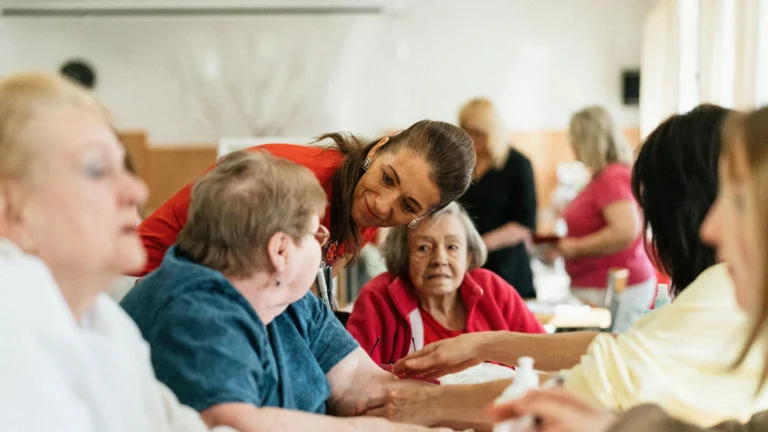
Designers can better understand a person’s characteristics and behaviors through the ways people relate to others. These relationships reveal a person’s place in their community and sometimes how they perceive themselves as part of that community.
Dynamic Self Factors
Relationships
Ways people are connected to others.
New parent
Caregiver
Estranged sibling
Close friends
More About Relationships
Opens the factor guide in new tab.
Ways people are connected to others.
Role
The functions a person plays in different situations.
Team leader
Student learner
Customer
First-time visitor
More About Role
Opens the factor guide in new tab.
The functions a person plays in different situations.
Gender Expression
The outward presentation of a person's gender through clothing, behavior, hairstyle, voice, and other expressive cues.
Masculine presentation
Feminine style
Androgynous look
Non-conforming dress
More About Gender Expression
Opens the factor guide in new tab.
The outward presentation of a person’s gender through clothing, behavior, hairstyle, voice, and other expressive cues.
Complex Self Factors
Race
A person's perceived physical traits shaped by historical and cultural contexts.
Black
White
Asian
Indigenous
More About Race
Opens the factor guide in new tab.
A person’s perceived physical traits shaped by historical and cultural contexts.
Social Class
A classification based on a person's socio-economic status, including factors such as income, education, and occupation.
Working class
Upper middle class
Experiencing poverty
Wealthy elite
More About Social Class
Opens the factor guide in new tab.
A classification based on a person’s socio-economic status, including factors such as income, education, and occupation.
Personality
A person's distinctive character.
Extroverted networker
Introverted thinker
Risk-taker
Cautious planner
More About Personality
Opens the factor guide in new tab.
A person’s distinctive character.
Sexual Orientation
Patterns of emotional, romantic, and/or sexual attraction to others.
Gay
Bisexual
Asexual
Heterosexual
More About Sexual Orientation
Opens the factor guide in new tab.
Patterns of emotional, romantic, and/or sexual attraction to others.
Subjective Norm
A person's perception of how others will judge or expect them to behave.
Peer expectations
Family pressure
Community norms
Social media influence
More About Subjective Norm
Opens the factor guide in new tab.
What a person believes others will think of them when they perform a behavior.
Underlying Self Factors
Culture
Shared beliefs, values, traditions, and behavioral patterns that shape how a group understands and interacts with the world.
Collectivist mindset
Individualist approach
Traditional practices
Cultural hybrid
More About Culture
Opens the factor guide in new tab.
Shared beliefs, values, traditions, and behavioral patterns that shape how a group understands and interacts with the world.
Intention
A person's determination to complete an activity.
Determined to succeed
Half-hearted effort
Uncertain purpose
Strong commitment
More About Intention
Opens the factor guide in new tab.
A person’s determination to complete an activity.
Relatedness
The feeling of being connected to others through meaningful relationships and interactions.
Core Self Factors
Sensations
Physical sensations such as pain or coldness.
Sharp pain
Comfortable warmth
Refreshing coolness
Unpleasant itch
More About Sensations
Opens the factor guide in new tab.
Physical sensations such as pain or coldness.
Mood
A person's underlying emotional state.
Joyful
Irritable
Melancholic
Peaceful
More About Mood
Opens the factor guide in new tab.
A person’s underlying emotional state.
Updated:
June 4, 2026 12:02 PM EDT
Customize Cookie Preferences