The Experience Design Factors (XDF) framework isolates concepts that make up designed experiences, from “big E” experiences like escape rooms and concerts to “little e” experiences like using a smartphone app or unboxing a commemorative coffee mug, so designers of any kind can determine which parts of a “Big E” or “Little e” experience design enhance people’s experiences and which harm them. The framework is a granular, block-by-block way of decoding and building design that’s useful, usable, desirable, and, most of all, memorable. If you want to design at the experience level, XDF is a magnifying glass that can help you identify what matters.
To build XDF, I researched academic literature and practitioner thinking across disciplines concerned with understanding human experiences and design. Experts in business, design, social, natural, and formal sciences, philosophy, and art have much to say about experiences. Some shared specifically about design’s role in creating experiences. Other sources explored what it means to experience. After two years of development and three more years of testing and refinement, a lexicon coalesced—Experience Design Factors (XDF)—59 factors representing matters that determine an experience design’s success.
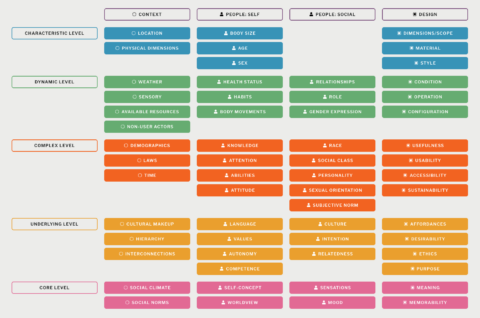
Factors that shape people’s experiences exist at many levels—some are easily observed, others are harder to determine, and others are invisible and require finely tuned sensibilities to isolate. Think of these sensibilities like lenses for seeing. When we put on different lenses, we can better understand contexts, people, and design that make up an experience. XDF calls these lenses “levels,” and factors are organized in five levels of increasing depth. Factors at the Characteristic level are easy to observe. Those at the core level are foundationally potent but not always easy for people to articulate.
Each factor is arranged as blocks in a grid. Explore these factors on the Factors page and use XDF to decode a product, service, or system you’re designing or to improve an existing design.
Learn more about XDF’s formation and design for experiences in the Theory for Designing Experiences, About Experience Design, and Why XDF? Sections below.